


Bachelor of Science in Artificial Intelligence

Science degrees are college programs that prepare students for careers in biology, chemistry, physics, environmental science, healthcare, research and other STEM fields. Available at the bachelor's and master's levels, these programs may be offered online, on campus or in hybrid formats. Students develop skills in scientific research, laboratory techniques, critical thinking, data analysis and problem-solving while studying subjects such as genetics, microbiology, biochemistry and ecology.
Graduates may pursue careers in healthcare, biotechnology, environmental conservation, education, government or scientific research, applying evidence-based knowledge to solve challenges and advance innovation across industries.

Students interested in pursuing a STEM career can choose from a wide range of science degree options in varying fields. Study the structure and function of organisms as a biology major, or examine how to support criminal investigations as a forensic science student. Explore the complex interplay of ecosystems in environmental science programs or choose from options in chemistry, health science or exercise science.
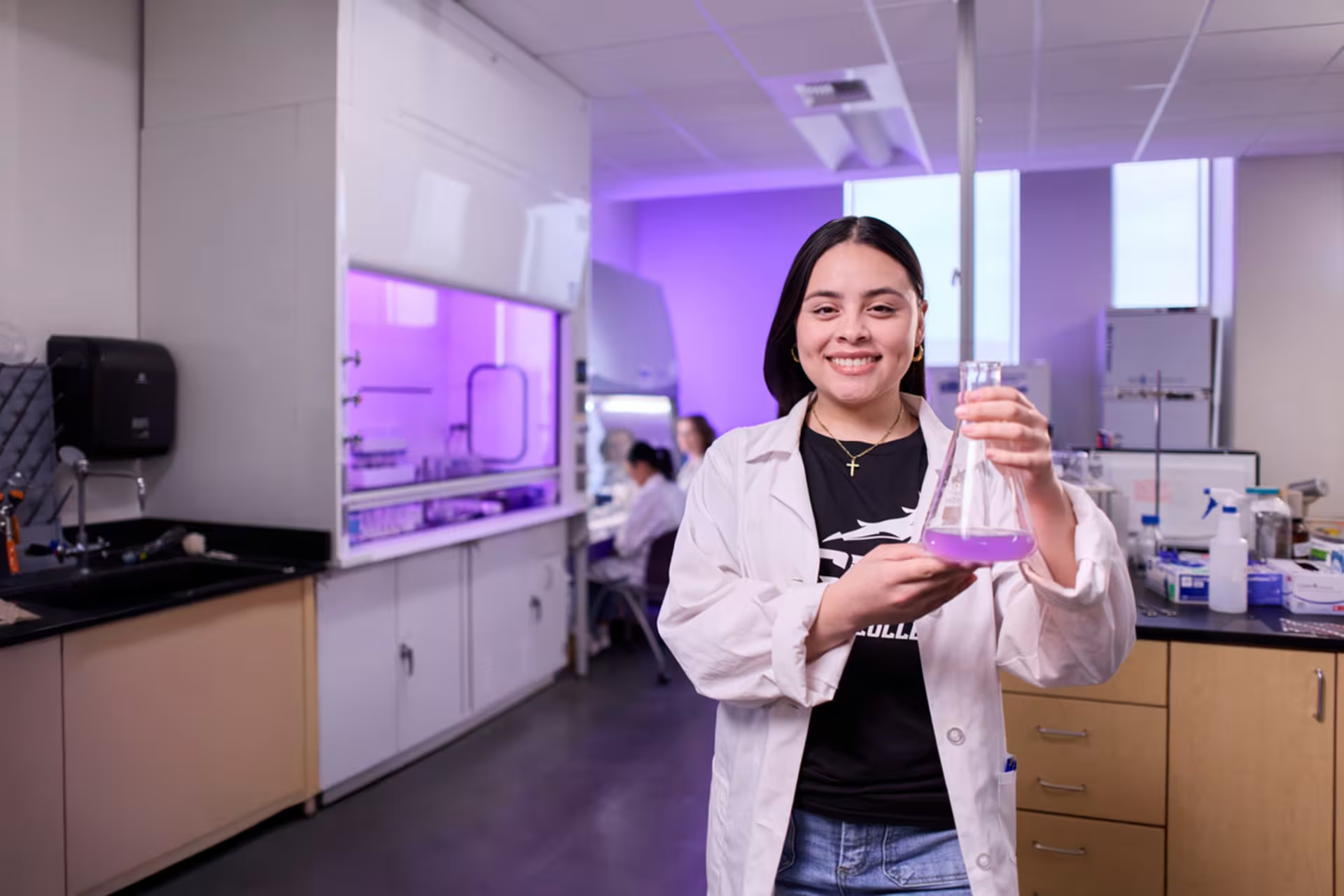
Study living organisms and how they grow, function, evolve and interact with other organisms and their ecosystems. Biology students explore cell theory, genetics, microorganisms and more in didactic coursework and laboratory experiments.

Study how scientific methods and techniques can be applied to the criminal justice system by supporting the efforts of criminal investigators and prosecutors. Practice analyzing samples using laboratory equipment and explore key concepts in toxicology and analytical chemistry.

The health science field brings together disciplines to provide foundational education for future allied health professionals. Study healthcare regulations, professional ethics, healthcare systems, the delivery of care and the application of scientific research to patient care.

Study the effects of movement and exercise on the human body and explore how biomechanics affect a person’s injury risk and sports performance. Explore the principles of kinesiology, guidelines for nutrition and practices for strength and conditioning.

Discover the fundamentals of the chemical structures, chemical bonding and chemical reactions that comprise the matter in the world around you. Chemistry majors may explore biochemistry, physical chemistry, organic chemistry and inorganic chemistry.

Study the Earth’s systems and ecosystems, its plants and animals and how environmental health affects human lives. Explore field and laboratory techniques in environmental assessment, hazard identification and remediation, and gain an introduction to field research.
Begin your journey in postsecondary education with a bachelor’s degree in a science field that aligns with your academic interests and career goals. Prepare to pursue entry-level work in STEM fields while gaining a foundation of competencies in scientific research and methodologies.


Continue your education in science with a master’s degree. Examine advanced competencies in fields such as forensic science, biomedical engineering, chemistry, nutrition and dietetics or exercise physiology. Master’s-level science degrees online(See disclaimer 1) can fit the scheduling needs of working professionals.
Sharpen your competencies in a narrow area of focus with science certificate programs. Undergraduate and graduate certificate programs can teach advanced concepts in a specialized area without the need to commit to a full degree program.

65 Matching Degrees








"While here studying at GCU, the faculty encouraged me to get an internship. Coupling that internship with the coursework here at GCU, I was able to immediately get a career as a crime scene specialist back in my home state of Washington."
"While here studying at GCU, the faculty encouraged me to get an internship. Coupling that internship with the coursework here at GCU, I was able to immediately get a career as a crime scene specialist back in my home state of Washington."
Choosing a science degree starts with identifying the specific science field you’re interested in, along with your long-term career goals and preferred work environment. Some science programs are designed for students pursuing healthcare professions, while others prepare graduates for careers in research, environmental conservation, forensic investigation or human performance. Use the guide below to explore which science program may be right for you.
One of the main factors to consider when choosing a science degree is which discipline interests you the most. Consider the following:
Some students aspire to work in labs, while others prefer outdoor fieldwork. Consider your preferences when choosing a major.
Science graduates may choose to pursue advanced education in:
Choosing an undergraduate science degree that aligns with your intended graduate or professional program can help you complete prerequisite coursework and build relevant experience. Research the admission requirements for graduate or professional schools when planning your undergraduate major.
An on-campus or online(See disclaimer 1) science degree can lead to numerous opportunities in STEM fields. From working as a laboratory technician to teaching science students to investigating natural phenomena as a biological or life scientist, there are many science career paths to consider. Numerous industries hire professionals with a background in science, including healthcare, environmental protection, education and biotechnology.(See disclaimer 5)
Some careers that science degree graduates may pursue include:
Athletic trainer
Athletic trainers provide first aid and emergency stabilizing care, typically to athletes during practices and games.
Exercise physiologist
Exercise physiologists design strength and cardiovascular fitness programs to help patients manage chronic conditions and recover from injuries, illness or surgeries.
Forensic science technician
Forensic science technicians collect physical evidence at crime scenes and analyze the evidence in a lab to support criminal investigations.
Biological technician
Biological technicians set up lab equipment and conduct laboratory tests to support the work of scientists.
Agricultural technician
Agricultural technicians gather samples from crops, soil, seeds and livestock and test the samples to identify problems, such as diseases.
Science teacher
Science teachers educate students in scientific processes and principles, and in concepts that are specific to a particular branch of science. Public school teachers are required to obtain licensure in the state in which they plan to teach.(See disclaimer 7)
Median annual wage for athletic trainers as of May 2024(See disclaimer 6)
Median annual salary for forensic science technicians in May 2024(See disclaimer 8)
Explore the potential career paths you might take based on the science program you’re interested in. Choose from degrees and career pathways in biology, chemistry, forensic science and more.
Most STEM degrees at GCU are offered on campus, while some science programs are available online(See disclaimer 1) or with a hybrid format. Online(See disclaimer 1) science programs can offer more scheduling flexibility for working professionals and career changers. No matter how you earn your degree, you can benefit from student support and career services throughout your program.
Our online students receive access to instructors and peers via interactive features, technical support and discussion boards. On-campus students can use the laboratory spaces from day one and participate in a variety of club and activities.

Explore these frequently asked questions to learn more about on-campus and online(See disclaimer 1) science degrees, as well as possible career pathways.
Is a science degree worth it?
What types of science degrees are available?
Can I go to medical school with a science degree?
Can you earn a science degree online?
Do science degree programs include internships, fieldwork or research opportunities?
What industries can you work in with a science degree?
Several science degrees have received programmatic accreditation. Explore the accreditation page of the College of Natural Sciences to learn more about programmatic accreditation.
GCU has been institutionally accredited by the Higher Learning Commission since 1968. The College of Natural Sciences shares the university’s commitment to upholding the principles and standards established by our accrediting bodies.
We believe that quality higher education should be accessible to all. We’re committed to keeping tuition for our academic programs competitive for our students by freezing on-campus tuition rates and offering millions in institutional scholarships. An education at GCU is an investment in your future.
Discover Your Financial Options
Connect with a university counselor to discuss tuition, cost-planning resources and available options.
Your education is an important financial investment, and there are several ways to help manage costs while earning your degree. GCU’s university counselors are available to help you explore available options and provide personalized guidance on your estimated cost of attendance.
Complete the Free Application for Federal Student Aid (FAFSA) annually to determine eligibility for federal grants and student loans. Since some aid is awarded on a first‑come, first‑served basis, GCU recommends submitting the FAFSA as early as possible after Oct. 1 to maximize funding opportunities.
If you’ve earned college credits from another institution, you may be able to complete your degree sooner at GCU by transferring those credits. Submit the Lopes Unofficial Credit Evaluation form, then connect with a university counselor who can provide you with personalized guidance.
You may be able to reduce your college costs by applying for GCU’s on-campus or online student scholarships. We invite you to explore available institutional scholarships and determine which opportunities you may be eligible for. GCU also encourages students to seek out third‑party scholarships and grants.
Our university does not require a personal statement or essay, and there is no application fee. High school students may meet the admission requirements with either a minimum GPA or SAT or ACT exam scores. Graduate students may meet the admission requirements with either a minimum GPA or GRE or GMAT scores.
You can apply to a degree program at GCU in just three simple steps. Your university counselor is standing by to assist you with any questions about the application process.
It starts with selecting the program that aligns with your goals from one of GCU's 380+ academic programs — from undergraduate degrees to post-master’s certificate programs to doctoral degrees.
Pick your program
Explore our on-campus, online or evening cohort options under the Degree Programs page to find the right program for you.
Complete our online application
Your university counselor will direct you to the online application. Fill in all required information and submit the form.
Submit supporting documents
Submit your official transcripts and any relevant test scores, and confirm with your university counselor that all forms for your desired program are submitted.

Choose from science degrees in chemistry, environmental science, biology and more.
Excluding residencies, practicums, internships and field experience.

